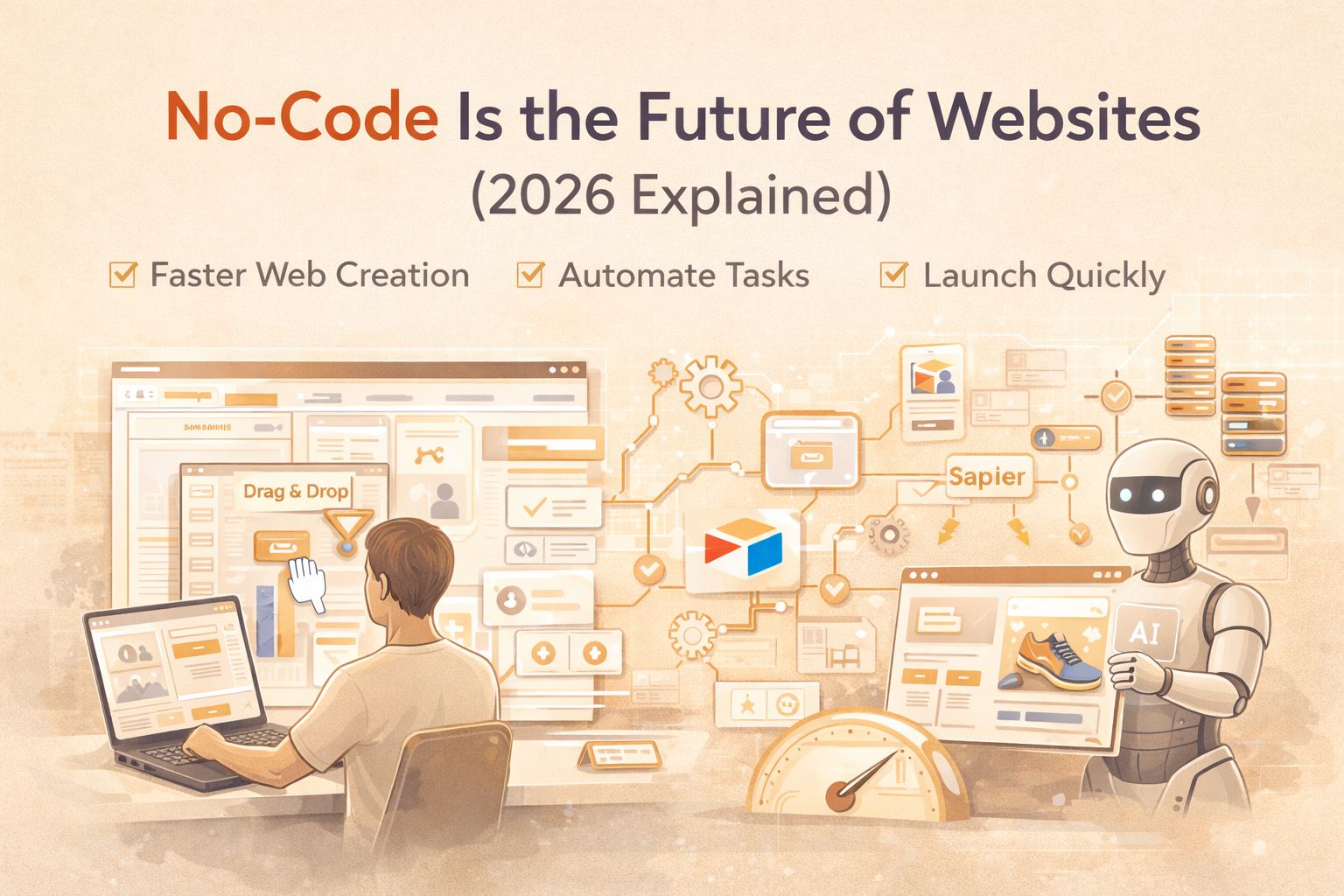
In 2026, one of the biggest shifts in web development isn’t about writing more code — it’s about writing less. No-code and low-code tools have rapidly evolved from simple page builders into powerful platforms capable of creating sophisticated websites, apps, databases, and automations without traditional programming. What once required weeks of development can now be achieved in days or even hours.
No-code platforms such as Webflow, Bubble, and Softr enable users to visually design interfaces, define workflows, and connect backend logic using intuitive interfaces. These tools abstract away complexity, enabling entrepreneurs, marketers, and small business owners to bring ideas to life without needing to master a programming language. This democratization of web development means that your next website or product does not have to wait for a developer to become real.
Automation is also a major part of the trend. Tools like Zapier, Make (formerly Integromat), and Airtable Integrations allow businesses to connect systems like CRM, email, forms, and payments without writing any backend code. Routine tasks such as lead capture, email follow-up, and data syncing can be automated in minutes, saving time and reducing human error. In 2026, this level of automation is not just a convenience — it’s a competitive advantage.
Another reason no-code is gaining traction is its support for experimentation. Startups can prototype ideas without heavy upfront investment. Instead of building an entire product before seeing customer feedback, founders can launch quickly, test concepts, and iterate based on real usage data. In an era where speed matters, this rapid cycle accelerates innovation.
That said, no-code doesn’t eliminate all coding needs. Complex, large-scale systems, performance optimizations, and highly custom logic still benefit from hand-crafted code. However, no-code platforms now integrate seamlessly with traditional development. For instance, a product may use a no-code frontend connected to a custom backend via APIs, giving the best of both worlds.
For business owners and founders who are not developers, understanding no-code is essential. It reduces dependency on technical resources, shortens time to market, and enables you to own and update your platform without external help. As digital products continue to become central to business growth, no-code tools are empowering a new wave of creators who think in terms of value and strategy — not just syntax.
At Techiesaie, we leverage no-code and low-code tools where appropriate to speed up delivery without compromising quality. Combined with custom development when needed, this hybrid approach helps businesses get online faster, adapt quicker, and innovate smarter.