How to spot AI delegation gaps without drowning in spreadsheets
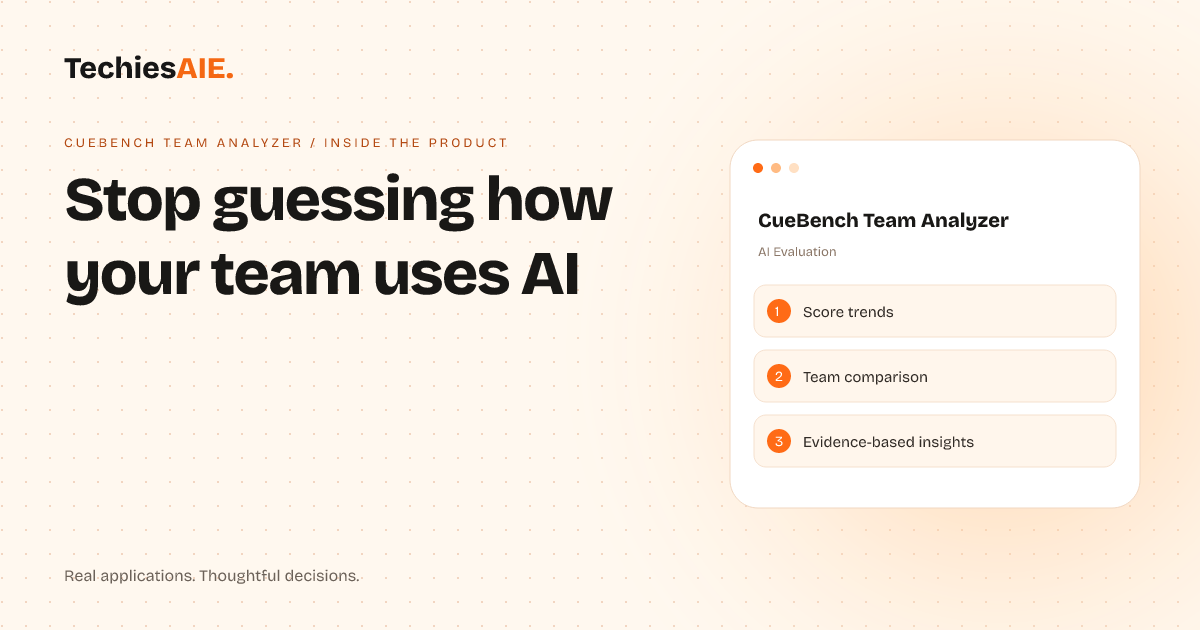
When your team’s AI workflows feel like a black box, this tool turns raw session data into clear trends—so you can coach where it matters most.
Every week, Priya’s team of five analysts spends 30 minutes sorting AI session logs into spreadsheets. They color-code who delegated tasks to AI, who double-checked outputs, and who ignored prompts entirely. The goal? To coach team members on when to trust AI—and when to step in. But the spreadsheets are messy. One analyst’s ‘Delegation’ column gets mixed with ‘Discernment’ notes. Another forgets to update scores after a busy sprint. By the time Priya spots a trend—like Team B delegating too much to AI on Friday afternoons—it’s too late to act.
CueBench Team Analyzer turns those messy logs into clear trends. Upload session files (or use the demo), and the tool automatically groups scores by team member, role, or even day of the week. No more guessing if ‘Delegation’ means handing off tasks or just asking AI for quick answers. The dashboard shows three key scores at a glance: Delegation (how often tasks are handed to AI), Discernment (how well outputs are reviewed), and Diligence (whether follow-ups happen). See the dashboard in action
How it helps with real work
Priya’s first use case: spotting delegation blind spots. The tool’s line chart shows Team A’s Delegation score dipping on Mondays. A quick click reveals three analysts consistently handing off complex client emails to AI—but then spending extra time fixing mistakes. The ‘Evidence-based insights’ panel pulls up actual session logs where AI misclassified tone in replies. Now Priya knows to coach on ‘Delegation thresholds’: when to let AI draft, and when to review first.
Next, she compares teams. The ‘Team comparison’ view flags Team B as over-relying on AI for ‘Diligence’ tasks (like follow-up reminders). Their scores show they delegate 60% of reminders to AI—but only 30% of those reminders get sent on time. Priya schedules a 15-minute team chat: ‘Let’s pick one high-stakes task where we don’t delegate Diligence.’ The tool’s insights give her the exact examples to discuss.
Finally, she uses the trends to set priorities. The dashboard highlights ‘coaching opportunities’—like Team C’s sharp drop in Discernment after lunch. Priya adds a note: ‘Let’s test a 10-minute daily review ritual for AI outputs.’ No more vague ‘trust the process’ advice. The data shows where trust is breaking down.
What it can’t do (yet)
The tool assumes your AI sessions already log Delegation, Discernment, and Diligence scores. If your team tracks different metrics—like ‘AI confidence scores’ or ‘human review time’—you’ll need to adapt the input format. Also, it doesn’t suggest how to fix gaps. Priya’s coaching notes are manual. For that, you’d need a separate system (or a custom integration to tie insights to training modules). Explore TechiesAIE software services
What a similar project would need
If your team uses AI for tasks like customer support, coding, or content drafting, you’d want to start with the same three score types—but tailor them. For example, a coding team might track ‘Delegation’ as ‘how often PR reviews are handed to AI,’ and ‘Diligence’ as ‘whether AI-suggested fixes get tested.’ You’d also need to decide: Should the tool flag individual gaps (for 1:1 coaching) or role-based trends (for team-wide training)? Priya’s version focuses on roles to avoid singling out people.
For a project like this, you’d likely need to build a custom dashboard that connects to your AI session logs. TechiesAIE could help design the scoring system, automate the upload process, and add features like Priya’s coaching notes—so you’re not stuck explaining trends in spreadsheets again.
Other teams using similar tools might adapt CueBench for different workflows. A marketing team could track how often AI drafts social posts get published vs. edited. A development team might monitor which types of bugs AI flags get fixed without human review. The core idea stays the same: turn raw session data into actionable trends.