How a Mumbai-based tailor stops losing customers to ‘Where are you?’ confusion
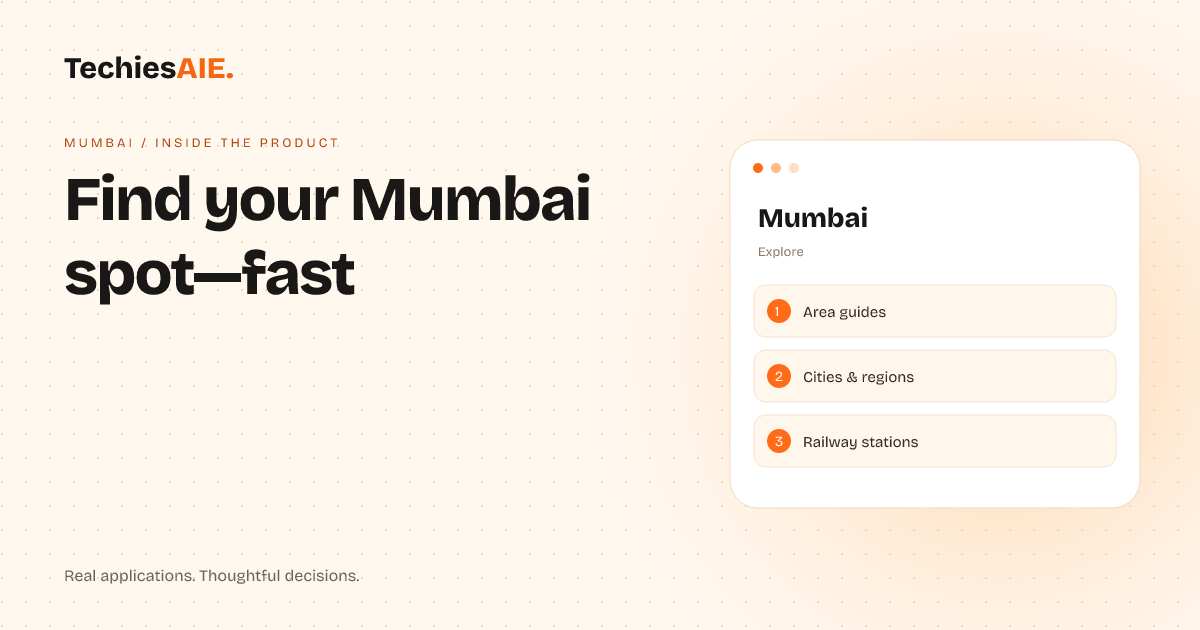
A Mumbai tailor explains how Mumbai’s app helps customers find his shop and nearby services—without building a custom website or spending hours on directions.
Rajesh runs a tailor shop in Andheri, Mumbai. Every day, customers call or visit asking, “Where exactly is your shop?” or “Which station should I get down at?” His shop isn’t on Google Maps, and his website only shows a basic address. Rajesh spends 30 minutes a day explaining directions or sending photos of landmarks. The real issue? Customers don’t just want an address—they want to see if the shop is near a station, a park, or a chai stall. Mumbai’s app solves this by turning his shop into a neighbourhood guide—no coding needed. Explore Mumbai
The app lets Rajesh’s customers tap a map to see his shop’s exact spot, along with nearby railway stations (like Andheri West) and local landmarks. No more guessing if the shop is a 5-minute walk from the station. The app also shows Andheri’s highlights—like the SBI ATM or nearby parks—so visitors feel like they’re part of the area. This isn’t just a pin on a map; it’s a way to say, “This is where we are, and here’s what’s around us.” Learn more about how the app works. Explore TechiesAIE website services
How the app helps customers find you—without a custom website
The app starts with a neighbourhood guide. Rajesh picks Andheri from a list of 703 Mumbai areas. The guide shows his shop’s location, the nearest station (Andheri West), and a photo of the street. Customers don’t need to dig for details—they see it all in one place. This works for any small business, from a café in Colaba to a gym in Powai. Rajesh can also add a short description, like “Tailoring services, 3-minute walk from Andheri West station.” No technical skills are needed.
Next, the app connects his shop to railway lines. Andheri is on the Western Line, so the guide shows the nearest station (Andheri West) and walking time. This helps commuters plan their visit. For example, a customer from Churchgate can see the train route and estimate travel time. The app also lists all 135 Mumbai stations, so if Rajesh later opens a second shop near Dadar, he can update the guide in minutes.
Finally, the app highlights local spots. Andheri’s guide includes nearby landmarks like the SBI ATM or local parks. This helps customers picture their visit—“I’ll stop by the tailor after my walk at the park.” Rajesh can also add his own spots, like “Best samosas at the corner shop.” This turns his tailor shop into a trusted local guide, not just a business address.
What the app doesn’t do—and why that matters
The app isn’t a full website or booking system. Rajesh can’t take online orders or add a detailed menu through it. But that’s the point: it’s built for one job—helping customers find his shop and understand its neighbourhood. If he later wants to sell online or manage appointments, he could use a template like ManuCrafts and link it here. The app focuses on location and trust, not ecommerce.
Another limit: the app uses community-sourced suggestions. Every area guide is reviewed, but some details (like exact street addresses) aren’t verified. For Rajesh, this isn’t a problem—he adds his own shop details manually. But if he needed 100% accuracy for a high-end service (like a law firm), he’d need a custom map integration. For most small businesses, though, the app’s simplicity works perfectly.
What a similar project would need
If Rajesh wanted to expand this idea, he’d need three things: 1) a custom map (to verify exact addresses), 2) a way to link to his WhatsApp or website (for orders or appointments), and 3) mobile-friendly updates (so customers see real-time info, like “Today’s special: discount on shirts”). The Mumbai app covers the first part—location and neighbourhood trust—but the rest would require a simple website or chat tool.
For example, a restaurant owner in Bandra could use the Mumbai app to show her spot near Bandstand, then link to her Olive-style store for online orders. Or a gym owner in Thane could list his shop’s location and nearby metro stations, then add a WhatsApp button for membership sign-ups. The app handles the “Where are you?” part; the rest depends on the business’s needs.
The key takeaway: Mumbai’s app solves a real pain point—helping customers find you in a crowded city—without the hassle of custom software. If you’re a small business in Mumbai and want to show your location, neighbourhood highlights, and services in one place, this could be a great start. Need something more tailored? Let’s talk.