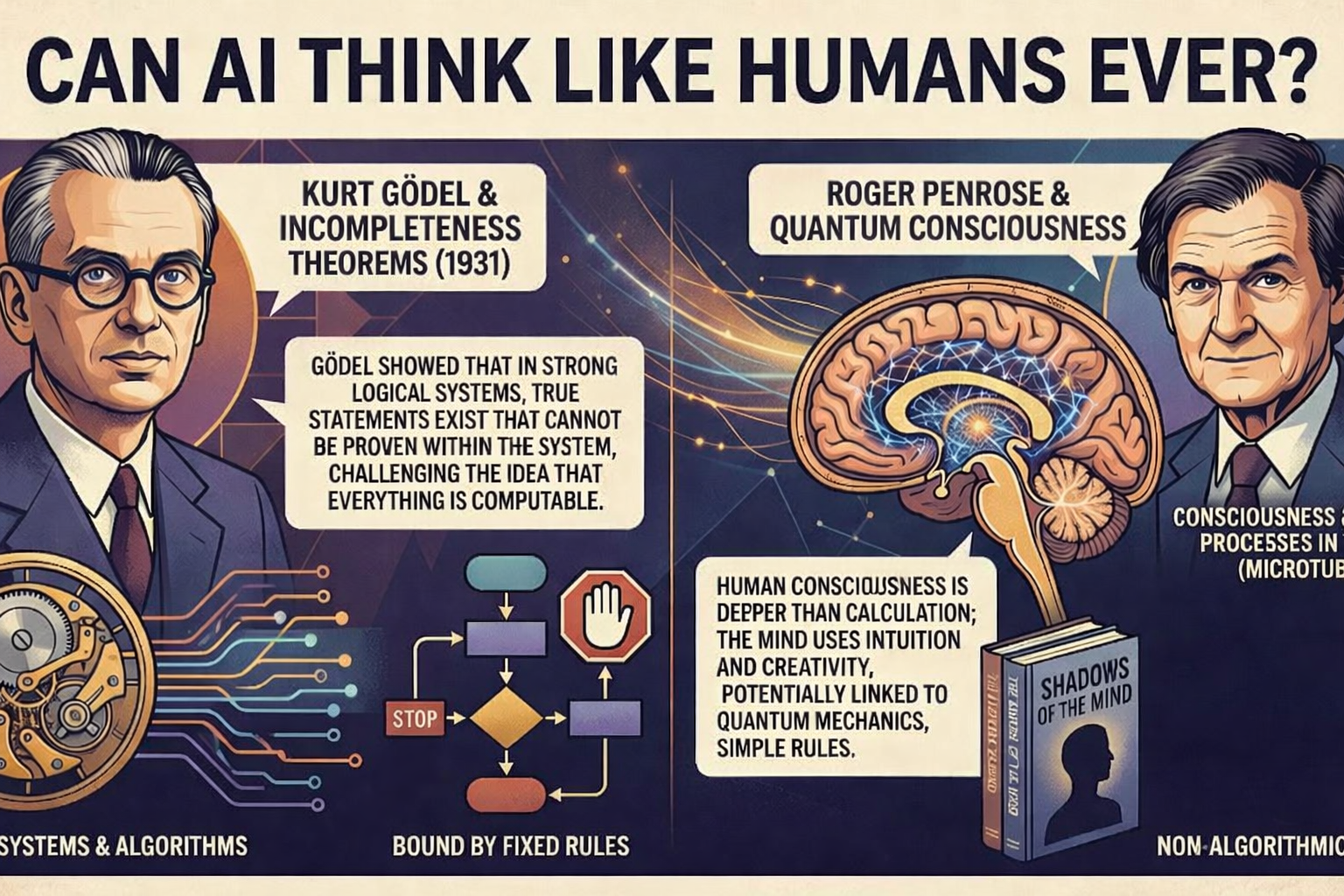

In today's world of such big and Advanced llms, One question always rises can ai think like humans? and you do a research and come to a decision, "ok maybe not right now but what about 'EVER??'". In the whole history of humanity, CAN AI THINK LIKE HUMANS EVER??? Many researches, historians and tech people have debated this, but its not possible to consider them all, But there are two people which i think are mention-worthy or whose research i consider most relevant out of them. Obviously I have not read all of them, but in this advanced era of ai, you dont need to read full books to research for a certain topic, but i gathered names and their books and found their answer to this question, But i would only like to discuss two of them and they are Roger Penrose and Kurt Gödel. Gödel’s incompleteness theorems, introduced in 1931, revealed a surprising limitation of formal systems like mathematics. In simple definition, they show that in any logical system, which is strong enough to describe basic arithmetic, there are statements that are true but cannot be proven within that system. Now, this challenges the idea that everything can be reduced to rules and calculation. Since we all know, computers strictly operate through algorithms and formal rules, Penrose argues that they are bound by those same limitations. Humans, on the other hand, have this strange ability to see that something is true even when there’s no formal proof for it. It’s like, our thinking goes a beyond those strict rules, regulations and step-by-step logic, which makes it feel like our brains aren’t just running on some fixed algorithm.
Building on this, Penrose says that "human consciousness is something deeper than just calculation, processiing or computing, Machines process things step by step, following whatever rules they are given. But humans, We don’t always think like that, we go by intuition, sudden insight, or even creativity, these are not so easy to fit into fixed rules or clear instructions.". In his books The Emperor's New Mind and Shadows of the Mind, Penrose even talks about the idea that consciousness might be connected to quantum processes happening inside the brain. But, this idea is quite controversial and not proven, but it still brings out one important thing, we don’t fully understand (yet) how human thinking actually works. And because of that, trying to copy or recreate it perfectly or better in machines is still quite impossible.
Even after all this, many researchers or historians still feel that AI might one day match or even go beyond human intelligence, just by using more advanced models and better processing. While some people praising penrose for this thoery, some critics also say that Penrose may be slightly overestimating the gap between how humans think and how machines work. But still, his ideas make us stop and think a bit deeper about what intelligence and consciousness actually mean. Whether machines will ever truly “think” like us or not, this whole discussion shows something very interesting, not just about technology, but about how little we still understand the human mind itself.